

Neuschwanstein is the castle you've already seen, on a thousand postcards, jigsaw boxes, and screensavers, and the rare bucket-list sight that genuinely lives up to it. The catch is that it's also one of the most logistically fiddly castles in Europe to actually get inside. Show up without a plan and you'll spend your morning in a ticket queue, miss your slot, and leave having only seen it from the car park.
So let's plan it properly. The view is free and spectacular; the interior takes some homework. Here's exactly how we'd do it.
Neuschwanstein at a glance
- Where
- Bavaria, Germany
- Nearest base
- Fussen
- Book
- Timed tour ahead
- Highlight
- Marienbrucke view
- How long: half a day for the castle, a full day with Hohenschwangau, 2–3 days for the wider loop
- Best time: shoulder months (May–June, late September–October); early morning always
- Getting there: about 2 hours by train from Munich plus a short bus, or base in Füssen
- Don't miss: the Marienbrücke view, the interior tour, and Hohenschwangau next door
What it costs (approximate, and the official ticket center sets the current rates):
| What | Roughly | Notes |
|---|---|---|
| Neuschwanstein tour | ~€21 | Timed guided tour; book ahead |
| Hohenschwangau tour | ~€21 | Next door; shares the ticket center |
| Königsschlösser combo | ~€32 | Both castles in one day |
| Shuttle bus up | ~€3 | Drops near the Marienbrücke |
| Horse-drawn carriage | ~€7–8 up | Stops short of the castle |
| Linderhof Palace | ~€10 | Near Oberammergau |
The Marienbrücke viewpoint, the photo everyone comes for, is free.
How the tickets actually work
This is the single thing that makes or breaks the day: you cannot wander into Neuschwanstein. Entry is by timed guided tour only, in a fixed-language group, and tours sell out, often days ahead in high season, and by mid-morning even in shoulder months.
Book online in advance through the official ticket center rather than gambling on same-day windows. A few things to internalize:
- Your ticket is for a specific tour time, not a flexible day pass. Miss it and it's gone.
- You collect or validate at the ticket center down in the village, then make your own way up to the castle, and that journey takes 30–40 minutes. Build that into your timing.
- The interior tour itself is short, around 30 minutes, and photography inside is not allowed.
Choose the earliest slot you can stomach. An early tour means thinner crowds at the viewpoint and a calmer climb. Current prices and opening hours are on the palace administration's neuschwanstein.de, which links to the official ticket portal.
Some links on this page are affiliate links. If you book through them we may earn a small commission, at no extra cost to you. It helps keep our guides free. We only recommend what we’d book ourselves.
Getting there
You have two sensible approaches. The first, and the one we prefer, is to base in Füssen, the handsome little town just below the castles. Staying here means you're first up the hill, you're not racing a train timetable, and you've got the wider Bavarian Alps on your doorstep (see where to stay in the Bavarian Alps, or weigh the castle base against the high peaks in Füssen vs Garmisch-Partenkirchen).
 Found on Booking.com
Füssen, Germany
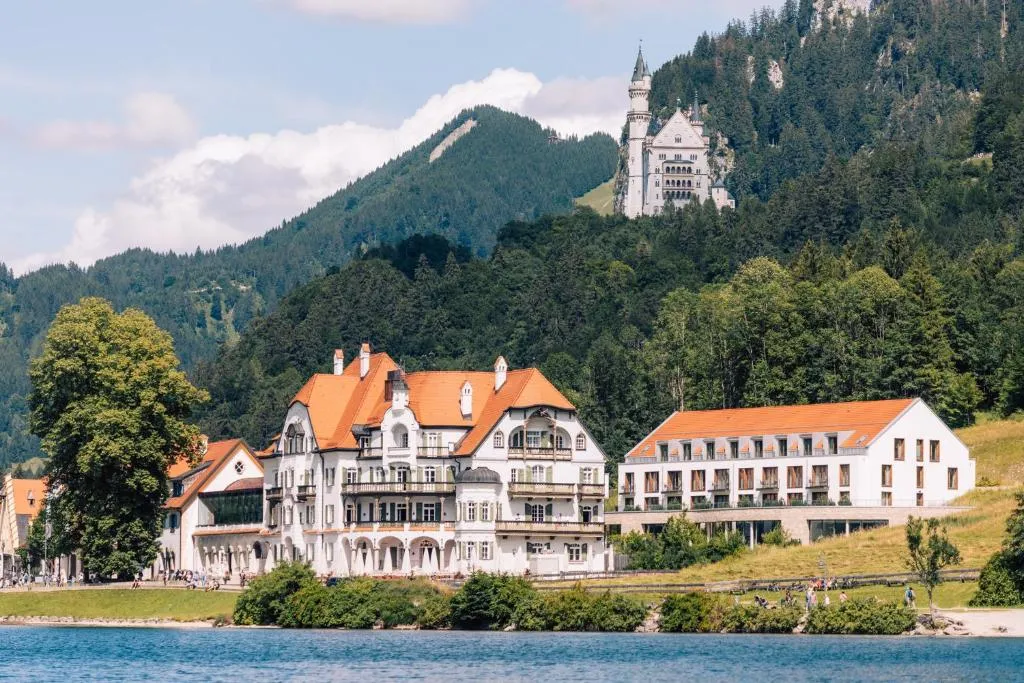
AMERON Neuschwanstein Alpsee Resort
For the two nights in Füssen we'd actually book, AMERON Neuschwanstein Alpsee Resort is the one that makes the castle feel like the main event rather than a day trip. It sits on the Alpsee, the lake directly below Neuschwanstein and Hohenschwangau, so you wake up already looking at what you came to see. Rooms are modern and calm rather than fussy, with a spa that earns its keep after the uphill walk. It's a splurge next to the village guesthouses, worth it for the setting alone. Book the lake-facing rooms if you can.
- Best for
- Lake-view splurge near Neuschwanstein
The second is a day trip from Munich. It's very doable: a direct train to Füssen takes roughly two hours, then a short local bus (the 73 or 78) drops you at the castles in about ten minutes. Driving is faster and more flexible, with large paid car parks in the village. (Our Munich as a base and Bavarian Alps by train or car guides cover both options.) Whichever you choose, the golden rule holds, go early. A 9am castle is a different, better place than a 1pm one.
The Marienbrücke, the view you came for
Here's the thing most first-timers get backwards: the iconic photograph of Neuschwanstein is not taken from the castle. It's taken from the Marienbrücke, a slender footbridge slung across the Pöllat Gorge a short, steep walk above the castle itself.
From the bridge you get the full fairytale: the white turrets, the forested hillside, the lake-dotted plain below. It is, hands down, the best vantage point, and it's free. Go here before your tour if your timing allows. The light is better in the morning and the bridge is narrow, so it bottlenecks fast once the day-trippers arrive.
One important caveat: the Marienbrücke can close in winter ice, high wind, or for maintenance. If the view is your whole reason for coming, check its status before you commit to a date.
The walk up vs. the shuttle or carriage
From the ticket center, you've three ways up to the castle:
- On foot: A roughly 30–40 minute uphill walk on a paved road through the woods. It's a genuine climb but perfectly manageable, and it's free. This is our default.
- Shuttle bus: A small paid bus runs up most of the way, dropping you near the Marienbrücke (handy. That puts the viewpoint first). It doesn't run in poor weather or hard winter.
- Horse-drawn carriage: Slower than the walk and pricier, but a charming, knees-grateful option, especially with kids or on a hot day. It stops short of the castle, leaving a final few minutes uphill.
Whatever you pick, don't cut your timing fine. The shuttle queue can swallow 20 minutes on a busy afternoon, and missing your tour slot is a real and common way to ruin the day.
The other Ludwig II castles
Neuschwanstein was the dream of "Mad King" Ludwig II, and he left a small constellation of palaces worth knowing.
Right next door is Hohenschwangau, the sunny yellow castle where Ludwig grew up. It's a different, more lived-in, genuinely historic place, and the easy add-on, since it shares the same valley and ticket center. Seeing both in one day is the classic move.
Further afield, his other fantasies reward a longer trip. Linderhof, near Oberammergau, is the only palace Ludwig actually finished, an intimate, gilded jewel-box with absurd, wonderful gardens. And Herrenchiemsee, on an island in the Chiemsee lake, is his unfinished homage to Versailles. Both make superb stops on a wider Germany loop. Hours and tickets for both are listed by the Bavarian palace administration.
When to go to dodge the crowds
The honest answer: early morning, always. The first tours of the day are calmer at every chokepoint, bridge, shuttle, climb, and gift shop.
For seasons, shoulder months (May, June, late September, October) give you mild weather and a fraction of the August scrum. Summer is busiest by a wide margin; if you must come in July or August, book ahead and take the earliest slot, full stop.
Winter is magical. Snow on the turrets is the postcard made real, but go in with eyes open: shorter hours, possible closures, and a Marienbrücke that may well be shut. Stunning if it lines up, deflating if it doesn't. (For the wider seasonal call, see the best time to visit the Bavarian Alps.)
The biggest mistake
It's this: treating Neuschwanstein as something you can do on a whim. People arrive ticketless at midday in July, find every tour sold out, queue for an hour at the shuttle, and end up photographing the castle from across the valley with a sandwich. The castle didn't disappoint them. The plan did.
What we'd do
Ready to build the trip around it? Find your perfect Alps base.


