

Bled gets the postcard. Bohinj gets the rest of you. If Lake Bled is the manicured front garden of the Julian Alps, island church, clifftop castle, cream cakes, then Lake Bohinj, twenty minutes up the valley, is the wild back country it's protecting. It sits entirely inside Triglav National Park, ringed by 2,000-metre peaks, and it has the one thing Bled has long since traded away: silence. This is the lake we send people to when they say they want the Alps but not the queue.
Lake Bohinj at a glance
- How long: 2 to 3 nights (it rewards staying, not day-tripping)
- Best time: mid-June to September for the high trails; July–August for the huts and Triglav
- Getting there: about 30 minutes from Bled, 1.5 hours from Ljubljana; a car helps (seasonal bus from Bled)
- Don't miss: a dawn paddle, the Vogel cable car, the Mostnica Gorge, and the Seven Triglav Lakes Valley
- Country
- Slovenia
- Getting there
- 30 min from Bled
- Ideal stay
- 2–3 nights
- Best months
- Mid-June to September
What the headline activities cost (approximate, and they shift year to year):
| What | Roughly | Notes |
|---|---|---|
| Vogel cable car | ~€25 return | Up to 1,535m; restaurant at the top |
| Savica waterfall | ~€3–4 | 20-minute stepped path |
| Mostnica Gorge | ~€3 | Trail entry, Voje valley |
| SUP / kayak rental | ~€15–20 per hour | Calmest at dawn |
| Lakeside parking | ~€2–3 per hour | Tight at Ribčev Laz in summer |
The lake, the shoreline loop, and the swimming are free. Bohinj is a genuinely affordable base.
Bohinj as the wild antidote to Bled
The two lakes are barely 30 minutes apart, and the contrast is the whole point. Bled is built for photographs and weddings. Bohinj is built for swimming, paddling, and walking off into the trees. There are no grand hotels lining the shore, no fleet of rowboats ferrying tourists to a church on an island. There's a small Baroque church, a stone bridge, a handful of pensions, and a lot of water and mountain.
If you're genuinely torn, we've laid out the head-to-head in our Bled vs Bohinj comparison. But here's the short version: pick Bled if you want one perfect afternoon and a photo. Pick Bohinj if you want a base.
The lake
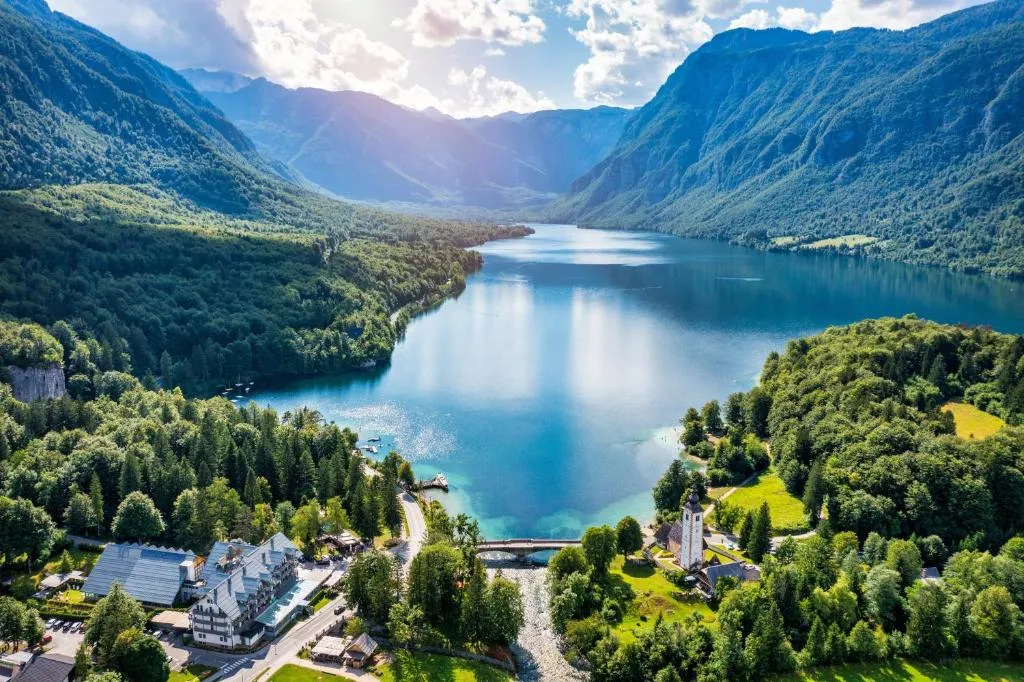
At roughly 4.2 kilometres long, Bohinj is Slovenia's largest natural lake, and unlike Bled it's a glacial lake fed by mountain streams, cold, clear, and ringed by forest rather than cafés. You can walk the whole shoreline loop in about three to four hours, and the western, roadless end (toward the Ukanc side) is where it goes properly quiet.
It's an excellent swimming lake; the water warms enough by July to be genuinely pleasant, and there are shallow grassy entry points near Ribčev Laz and Ukanc. Stand-up paddleboarding is the local obsession. Gliding out on glass-still water at 8 a.m. with the peaks reflected underneath you is one of those Alpine mornings you don't forget. At Ribčev Laz, the little church of St. John the Baptist sits beside the old stone bridge, its frescoed interior dating back centuries. It's the picture everyone takes, and rightly so.
The Vogel cable car & high views
For the view that explains everything, ride the Vogel cable car up from the lake's south-western corner. In a few minutes it lifts you from 569 metres to around 1,535 metres, and the whole lake unfurls below you with Triglav, Slovenia's highest peak, standing at the head of the valley.
In summer it's the easy way to get hikers and families up to high meadows and gentle ridge walks without a brutal climb; in winter it's a ski area. There's a mountain restaurant at the top, so you can earn the panorama with strudel rather than sweat.
The waterfalls & gorges
Two short trips bracket the lake's character. Above the western end, the Savica waterfall drops in a dramatic A-shaped cascade roughly 78 metres down a cliff face; it's a 20-minute walk up a stepped path from the car park, and it's the spring source that feeds the lake. It's touristy but worth it. Go in late spring or early summer when snowmelt has it thundering.
For something wilder and quieter, head to the Mostnica Gorge, just up the Voje valley from the village of Stara Fužina. A walking trail follows the Mostnica river as it carves through emerald rock pools and narrow channels. There's even a spot known as the "elephant," a rock formation in the stream. It's stroller-unfriendly but a brilliant family walk for kids who can handle a few hours on their feet.
The big hikes: Seven Lakes & Triglav
This is where Bohinj earns its place in serious hikers' notebooks. The Seven Triglav Lakes Valley (Dolina Triglavskih jezer) is the classic: a high, glacier-scoured valley strung with alpine lakes, reached on a long, steep day hike or, better, broken over two days with a night at a mountain hut. It's demanding, properly remote, and unforgettable.
And then there's Triglav itself, at 2,864 metres. Standing on the summit is a genuine Slovenian rite of passage. The mountain is on the national flag. But be clear-eyed: this is not a casual walk. It's a multi-day route involving exposed, cabled (via ferrata) sections near the top, and we'd strongly recommend going with a certified mountain guide unless you're an experienced scrambler with a head for heights. Most people overnight in a hut and summit on day two. Booking huts ahead in peak season is essential.
Some links on this page are affiliate links. If you book through them we may earn a small commission, at no extra cost to you. It helps keep our guides free. We only recommend what we’d book ourselves.
Getting there and around
Bohinj sits at the end of its own valley, so most people arrive by car: it's about 30 minutes from Bled and 1.5 hours from Ljubljana, and a rental car frees you to reach the Savica car park, the Mostnica trailhead, and the Vogel base on your own clock. A seasonal bus links Bled and Bohinj if you'd rather not drive, but service is limited. In peak summer, lakeside parking at Ribčev Laz fills early, so come first thing or use the park-and-ride. Bohinj pairs naturally with Bled on the lakes side and, over the Vršič Pass, with the Soča Valley.
How long & the best time
Give Bohinj two to three nights. Two covers the lake, the cable car, and a waterfall. Three lets you add a full mountain day. The high trails, Seven Lakes, Triglav, the Vogel ridge walks, are realistically open and snow-free from mid-June through September, with July and August the safest bet for the huts and the summit. Spring brings roaring waterfalls but lingering snow up high; autumn is gorgeous and quiet but shortens your high-mountain window. (For the full seasonal picture, see the best time to visit Slovenia's Julian Alps.)
The biggest mistake
Day-tripping it. People base in Bled or Ljubljana, drive over for two hours, photograph the church, and leave, and they completely miss the point. Bohinj reveals itself early and late: the dawn paddle, the empty shoreline at dusk, the cable car before the buses arrive. Stay on the lake, and it becomes a different, better trip.
What we'd do
It all slots into our 7 days in the Julian Alps itinerary, and where to stay in the Julian Alps sorts the bases.
 Found on Booking.comFrom €140/night
Lake Bohinj, Slovenia
Hotel Jezero
Hotel Jezero sits right at Ribčev Laz, close enough to the water that a pre-breakfast swim or a paddleboard session is a five-minute walk, not a plan. Rooms are plain and comfortable rather than showy, which suits Bohinj's whole unpolished character, and the lakeside terrace is exactly where you want to be after a long day on the Vogel ridge or the Seven Lakes trail. It's an easy base for families too, with the shoreline path and the little church just outside the door. Nothing fancy, just well placed.
- Guest rating
- 8.7 / 10
- From
- €140/night
- Best for
- Lakeside comfort for hikers
Bohinj isn't the easy choice. It's the right one.
Find your perfect Alps base and we'll build the rest of the trip around it.


